Visual artist Kevin Osepa was presented with the Prix de Rome for Visual Arts today by State Secretary Becking (Education, Culture and Science). Osepa won the award for his new work Lusgarda, taking into account his entire oeuvre. The artist will receive a €60,000 contribution. The Prix de Rome is an incentive award for talented visual artists who convincingly offer new insights into the visual arts in the Kingdom of the Netherlands, and contribute notably to its development.
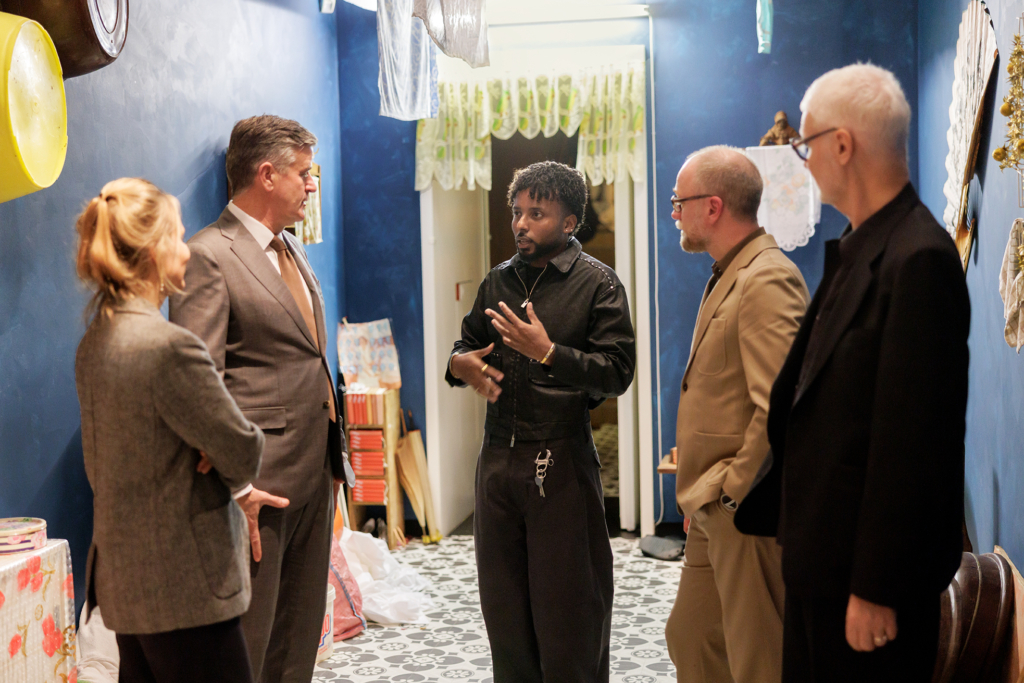
Lusgarda is a total installation that Osepa created especially for the Prix de Rome. It highlights the disappearing ritual of Ocho Dia, the eight-day mourning period after a funeral on his native island of Curaçao. A work that ‘overwhelms and moves,’ according to the jury in their report. ‘Lusgarda is a vibrant work that elevates both the recognizable and the concealed to a higher poetic level.’ The jury recognises Osepa as an artist with a highly distinctive visual language who has developed rapidly in both terms of narrative and expression, and continues to surpass himself: ‘In Lusgarda, all elements intertwine. Like a director, the artist empowers his collaborators, revalues a culture, and simultaneously delivers a work of great technical refinement while remaining true to his own narrative. The jury believes that with this work, and his strongly developed oeuvre, Osepa can stand alongside artists of international stature and represents a major promise for the future.’
Kevin Osepa’s Lusgarda explores individual and collective mourning, as well as the preservation of a tradition on the verge of fading away. Drawing on archival sources on Ocho Dia, Kevin Osepa has created an immersive experience that carries a kaleidoscope of layers of meaning. Some codes reveal themselves immediately, while others remain concealed. The jury believes that the inexplicable element is one of the work’s greatest strengths. With his contemporary interpretation of Ocho Dia, Osepa has created a deeply personal work that simultaneously speaks to universal emotions surrounding grief and the erosion of traditions. The jury sees a work that is expansive, cohesive and dramatic: ‘Through the use of everyday household objects, handmade dolls and a powerful film, the audience is drawn into an alternative reality. Osepa does not shy away from exuberant emotion or physicality.’
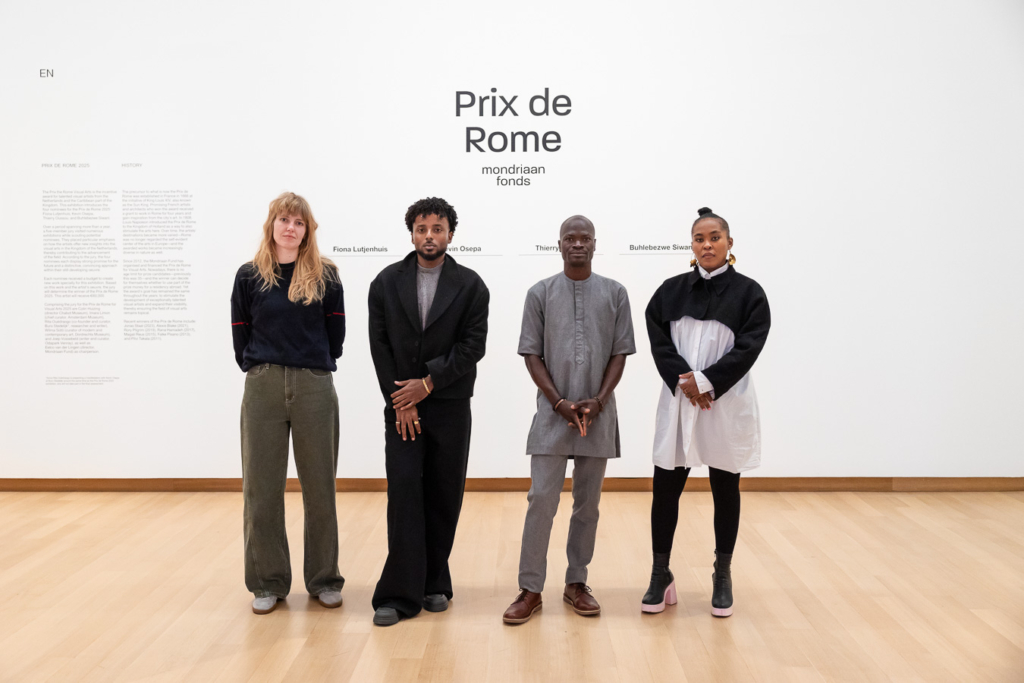
Fiona Lutjenhuis, Thierry Oussou and Buhlebezwe Siwani were also nominated for the Prix de Rome Visual Arts 2025. The jury observes that the four nominees have produced work on an impressive scale and acknowledges the considerable effort they have invested: ‘The result is an exceptionally vibrant edition of the Prix de Rome, with works rich in meticulously executed detail. The strong sense of movement in the works animates the exhibition space.’ The jury further notes that, despite the gravity of the themes addressed, there is a striking sense of freedom in how the artists approach their practice and how they position themselves in relation to art history: they move lightly through references, movements, materials and symbolism in ways that excite and inspire. Read the full jury report here.
All finalists were assessed based on their oeuvre to date and new work produced during a 4.5-month work period. The new works will be on display until 15 March 2026 at the Stedelijk Museum Amsterdam in the dedicated Prix de Rome exhibition.