Atelier Néerlandais

Nasrin Tabatabai and Babak Afrassiabi

Nasrin Tabatabai and Babak Afrassiabi began collaborating on a range of projects in 2004, mainly involving video, audio, sculptural installations and objects. They also publish the bilingual Farsi-English magazine Pages, the first issue of which was published in February 2004. Since then, their artistic work and the themes of the magazine have been closely connected, together forming an exploration of the relationship between history, archives and technology. Their work focuses on the way in which unfinished historical narratives and geopolitical developments influence and change the conditions of artistic production.

The work of Tabatabai and Afrassiabi has been presented internationally in both solo and group exhibitions, including at the Hamburger Kunsthalle, the Antoni Tàpies Foundation in Barcelona, the Istanbul Biennial, the Gwangju Biennale, Chisenhale Gallery in London, MACBA in Barcelona and Witte de With in Rotterdam. Their magazine Pages was part of Documenta 12 Magazines.

Part of The Space Between Breaths

Portrait Nasrin Tabatabai en Babak Afrassiabi

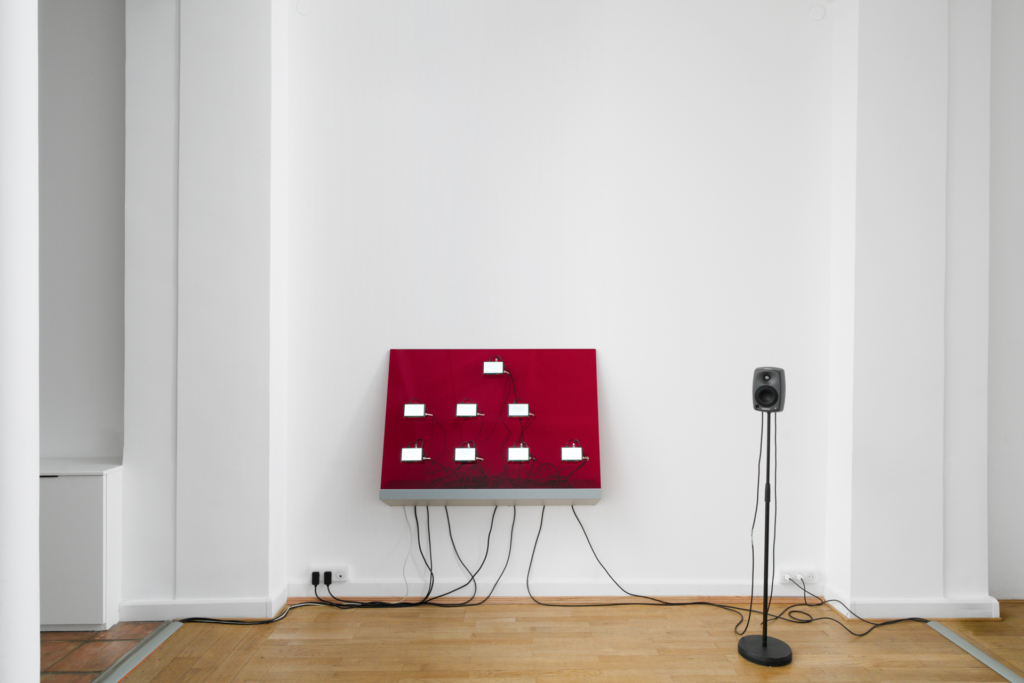
Nasrin Tabatabai & Babak Afrassiabi, Labour Lung, 2024. Computer-generated sound installation 8 Raspberry Pi computers, 8 displays and 5 audio-8 Raspberry Pi power supply adapters-8 patch cables-2 desktop switch with 2 power supply adapters-2 Power strips DACs-One plexiglass sheet (122 cm x 82 cm x 1,5 cm). Duration: ongoing real time sound. Courtesy of the artists. Photo: Pauline Assathiany

About Labour Lung, 2024

Nasrin Tabatabai & Babak Afrassiabi modelled the computer-controlled sound installation Labour Lung (2024) on the human lung. A network of computers uses probability models to simulate, in real time, the effects of opium smoke on the respiratory tract and the resulting changes in breathing sounds. The work explores the historical intertwining of human and technological organs and the role of the lung within the colonial opium trade. The spread of opium smoke not only facilitated the commercialisation of the drug but also linked the body and respiration to broader economic and political systems. Opium smoke emerges as a technology that produces sound and transcends the boundaries of the respiratory organ.