Atelier Néerlandais

Femke Herregraven

Femke Herregraven is an Amsterdam-based artist who explores the world-forming power of abstract systems. Across finance, prediction, language, ecology, and computation, she examines how models, values, and protocols actively shape landscapes, infrastructures, ecosystems, and everyday life. Her long-term research focuses on financial, geological, and climatological systems, including catastrophe bonds, extraction, and the ways uncertain futures are modelled, priced, and distributed as risk.

Between 2018 and 2024, she was part of On-Trade-Off, a transnational project on lithium extraction in the Democratic Republic of Congo. Her work has since expanded from the financial modelling of the future toward simulation and language models, examining how models shape both our experience of reality and the material ground on which it stands. In her multidisciplinary practice, she combines sculpture, installation, drawing, moving image, sound, simulation, and speculative fiction. Moving between textual, computational, sonic, and gestural forms, she investigates how abstract models produce material and sensory realities.

Her work has been presented internationally at institutions including Westfälischer Kunstverein Münster (2018), KCUA Kyoto (2023), RADIUS CCA Delft (2024), and Halle für Kunst Lüneburg (2026). Herregraven is an alumna of the Rijksakademie van beeldende kunsten (2017–2018) and received the title Creator Doctus from the Gerrit Rietveld Academie in 2024.

Part of The Space Between Breaths

Portrait Femke Herregraven. Photo: Stijn de Vries

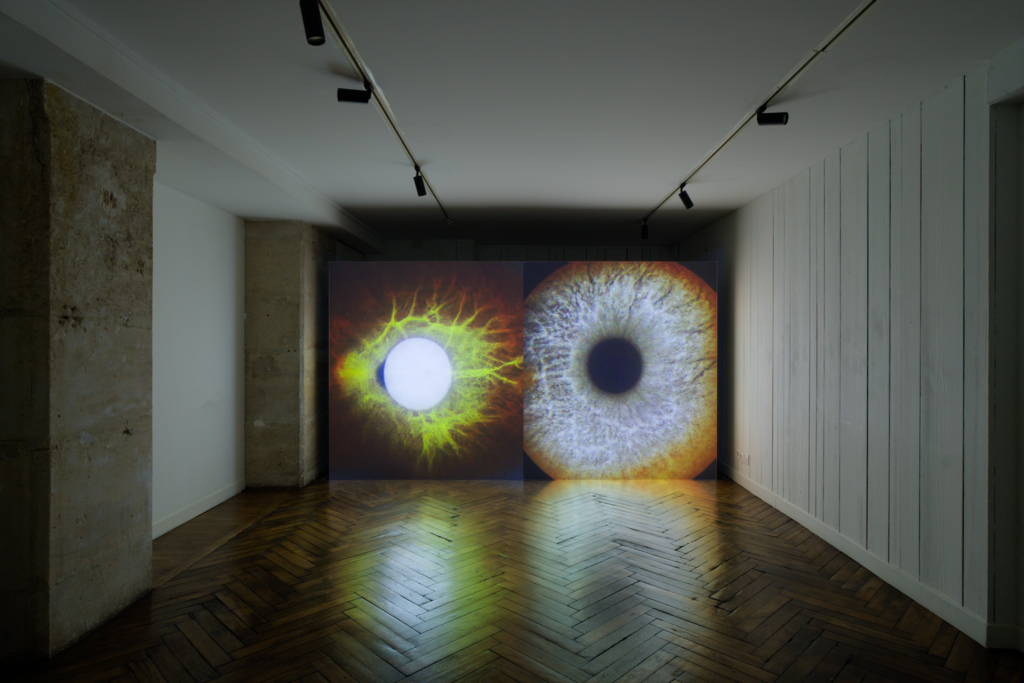
Femke Herregraven, The Murmur of the Dying, 2023. Video, stereo sound 10:40 min. Courtesy of the artist. Photo: Pauline Assathiany

About The Murmur of the Dying, 2023

In The Murmur of the Dying (2023), Femke Herregraven explores how artificial intelligence deals with forms of communication that fall outside the realm of language, such as sighs, breathing, murmuring and other involuntary sounds. AI systems are generally trained to interpret language as code and recognise meaningful patterns, whilst breathing sounds are often regarded as noise. Herregraven uses sound recordings of, amongst others, people with respiratory and speech disorders, but also of her own family, such as her children’s babbling and her parents’ breathing and murmuring on their deathbeds. In doing so, she questions the distinction between meaningful sound and noise. The film combines these recordings with thousands of medical scans of patients, used to train AI systems to recognise diseases and abnormalities. The work also features AI-generated images of a black cat, inspired by Oscar, a cat who became famous for seemingly sensing the impending death of terminally ill patients. Herregraven thus explores how breath and voice can convey connection when words fall short, and whether AI is capable of understanding such subtle, human forms of communication and empathy.